TCFD Report
In conformity with the Swiss Ordinance on Mandatory Climate Disclosures, Rieter has been implementing reporting on climate-related matters in alignment with the recommendations of the Task Force on Climate-related Financial Disclosures (TCFD) since January 1, 2024. This report outlines how Rieter identifies and manages the physical and transitional risks and opportunities associated with climate change that could have a financial impact on the Group. The eleven disclosures, as recommended by the TCFD, are divided into the sections Corporate Governance, Strategy, Risk Management, and Key Figures as well as Targets.
Corporate governance
Oversight of Board of Directors
The Board of Directors of Rieter Holding Ltd. defines the company’s sustainability strategy at the Group level and sets objectives and priorities. Climate-related matters are embedded in Rieter Group's sustainability strategy. The Board of Directors has committed to addressing sustainability aspects, including climate-related issues, separately in three Board meetings each year. In 2025, this took place as planned in three meetings.
In 2024, the Board of Directors mandated the Group Executive Committee to establish a Sustainability Committee to develop the conceptual framework for the implementation of the sustainability strategy. Climate-related matters are embedded in these activities. The Committee includes leaders from the areas of supply chain, finance, legal, occupational safety and environmental protection, communications, human resources and sustainability. The Committee meets every two months to assess progress on sustainability initiatives. Under the leadership of the CEO of Rieter, the Committee met six times in 2025.
For more information on Board oversight, see the Sustainability Strategy section under Sustainability Governance.
Role of the Group Executive Committee
The Group Executive Committee is responsible for implementing the sustainability strategy at the operational level and for monitoring the achievement of sustainability goals. Climate-related matters are embedded in Rieter’s sustainability strategy and supported by corresponding goals. The Group Executive Committee has committed itself to address sustainability issues, including climate-related matters, in at least three Executive Committee Meetings. This took place as planned three times in 2025.
For more information on the role of the Group Executive Committee, see the Sustainability Strategy section under Sustainability Governance.
Strategy
Climate-related risks and opportunities
Rieter continuously identifies, monitors and manages climate-related risks and opportunities on a short-term (one year), medium-term (two to five years) and long-term (more than five years) basis. Two categories of climate-related risks and opportunities are differentiated: physical risks and opportunities associated with changing climatic conditions, and risks and opportunities associated with the transition to a low-carbon economy. The risks and opportunities identified by Rieter are summarized in the subsequent table.
Impact of climate-related risks and opportunities
Physical risks and opportunities include on one hand the effects of short-term, acute extreme weather events such as severe storms, heavy rain/flooding, wildfires and landslides. These can result in damage to the Group’s own infrastructure or disruptions in the supply chain, such as supply bottlenecks, or can significantly impact logistics due to disrupted transportation routes. On the other hand, the physical risks and opportunities also include the longer-term chronic, localized effects of climate change. These include the effects of rising average temperatures and/or sea levels, as well as increased and longer periods of heat and drought.
Transitional risks arise from new political, legal, technological, social, market and reputational developments triggered by climate change. These include the pricing of CO2, compliance with new climate change legislation and regulations to protect the climate, the reliability of energy supply in the context of the energy transition, changing customer preferences towards sustainable products, the development of sustainable technologies, and the redirection of capital flows towards sustainable investments.
The climate-related risks and opportunities identified by Rieter, their impact on the Group and the measures taken are described in the following table. A distinction is made between the impacts, risks and opportunities for in-house production (own environmental footprint) and for Rieter’s customers and suppliers (supply chain).
Physical risks and opportunities
Type | Impacts on Rieter: risks and opportunities | Measures |
|---|---|---|
Acute | ||
Extreme weather events (storms, flooding, landslides, wildfires) and earthquakes | Risks Own production
Supply chain
Opportunities Supply chain
| Risk mitigation and exploitation of opportunities Own production
Own production and supply chain
|
Chronic | ||
Long-term local impacts (rising average temperature and sea level, more frequent and prolonged heat waves) | Risks Own production and supply chain
Opportunities Own production and supply chain
| Risk mitigation and exploitation of opportunities Own production
Supply chain
|
Biodiversity | Risks Own production and supply chain
Opportunities Own production and supply chain
Supply chain
| Risk mitigation and exploitation of opportunities Own production and supply chain
|
Transitional risks and opportunities
Type | Impacts on Rieter: risks and opportunities | Measures |
|---|---|---|
Regulatory and legal | ||
Pricing of greenhouse gases (e.g. in the form of a CO2 tax on fossil fuels) | Risks Own production and supply chain
Opportunities Supply chain
| Risk mitigation and exploitation of opportunities Own production
Supply chain
|
Introduction of new regulations and expansion of existing regulations at the local, national or global level | Risks Own production and supply chain
Opportunities Supply chain
| Risk mitigation and exploitation of opportunities Own production
Supply chain
|
Market | ||
Changing customer needs and preferences | Risks Supply chain
Opportunities Supply chain
| Risk mitigation and exploitation of opportunities Supply chain
|
Reputation | ||
Stakeholder expectations | Risks Own production and supply chain
Opportunities Own production and supply chain
| Risk mitigation and exploitation of opportunities Own production and supply chain
|
Technology | ||
Market penetration of new technologies for energy efficiency and the reduction of GHG emissions in own production and product range | Risks Own production
Opportunities Supply chain
| Risk mitigation and exploitation of opportunities Own production
Supply chain
|
Strategy resilience
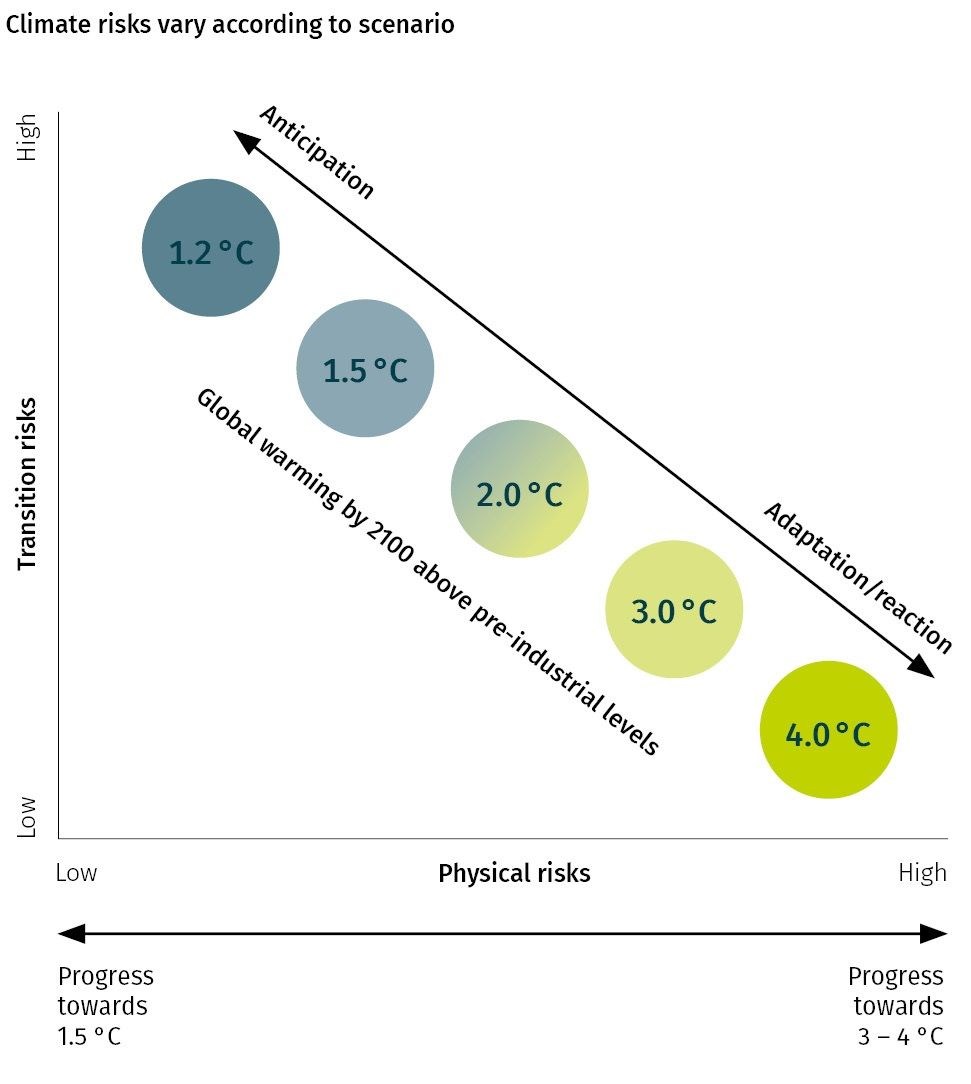
The faster climate change progresses, the greater the impact of physical risks. To slow global warming accordingly, various measures are needed, which tend to lead to higher transition risks.
_width-1240.jpeg)
In a net-zero scenario, transition risks such as policy, regulatory and legal risks dominate.
Physical risks, such as extreme weather events, storms, hurricanes and rising sea levels dominate in a low decarbonization and adaptation scenario.
Risk management
Process to identify and assess climate-related risks
The climate-related risks and opportunities described in the table were identified by the Corporate Risk and Insurance Management department and reviewed and confirmed by the Sustainability Committee. They were then integrated into existing workflows in all three divisions.
Processes for managing climate-related risks
The measures identified to manage climate-related risks are described in the table.
Integration of processes to identify, assess and manage climate-related risks
Rieter has implemented a comprehensive risk management system that also identifies and manages non-financial risks. The risk management process is governed by the “Rieter Risk Management System” directive. This directive defines the procedures for identifying, reporting and handling risks, the criteria for qualitative and quantitative risk assessment, and the thresholds for reporting identified risks to the appropriate management levels.
Environmental risks are also evaluated and assessed as part of the risk assessment. As a result, various areas for action have already been identified and risk mitigation measures have been implemented. At least once a year, the risks are assessed in a workshop led by the Head of Legal Services (General Counsel) and documented in a report to the Board of Directors.
Key figures and goals
Key figures to assess climate-related risks and opportunities
Rieter assesses its environmental footprint using the following key figures:
- greenhouse gas (GHG) emissions scope 1, scope 2 and partially scope 3,
- energy consumption and share of energy consumption in renewable sources,
- amount of waste generated during production and recycling rate as well as
- water withdrawal.
Water withdrawal in production has a smaller impact on Rieter’s environmental footprint than GHG emissions, energy consumption and waste volumes, as most processes are not water intensive. Rieter’s current materiality analysis therefore does not identify water as a topic of high relevance, and reporting on this topic will be discontinued after 2025. Nevertheless, Rieter continues to promote responsible water management throughout its operations.
GHG emissions and associated risks
Scope 1 GHG emissions include direct greenhouse gas emissions from sources owned or controlled by Rieter, such as emissions from a gas-powered heating system or a gasoline-powered company-owned vehicle.
Scope 2 GHG emissions include indirect GHG emissions from the generation of acquired or received electricity, steam, heat or cooling, such as emissions from purchased electricity.
Scope 3 GHG emissions include all indirect GHG emissions not covered by scope 2 that occur in Rieter’s upstream and downstream value chain.
Climate-related risks and opportunities
To reduce its own environmental footprint, Rieter has set targets in the following climate-related areas for the financial year 2025:
- Reduction of energy consumption at own locations,
- reduction of GHG emissions (scope 1 and scope 2),
- reduction of waste in the production of Rieter spinning systems and
- reduction of water withdrawal.