Sustainability strategy
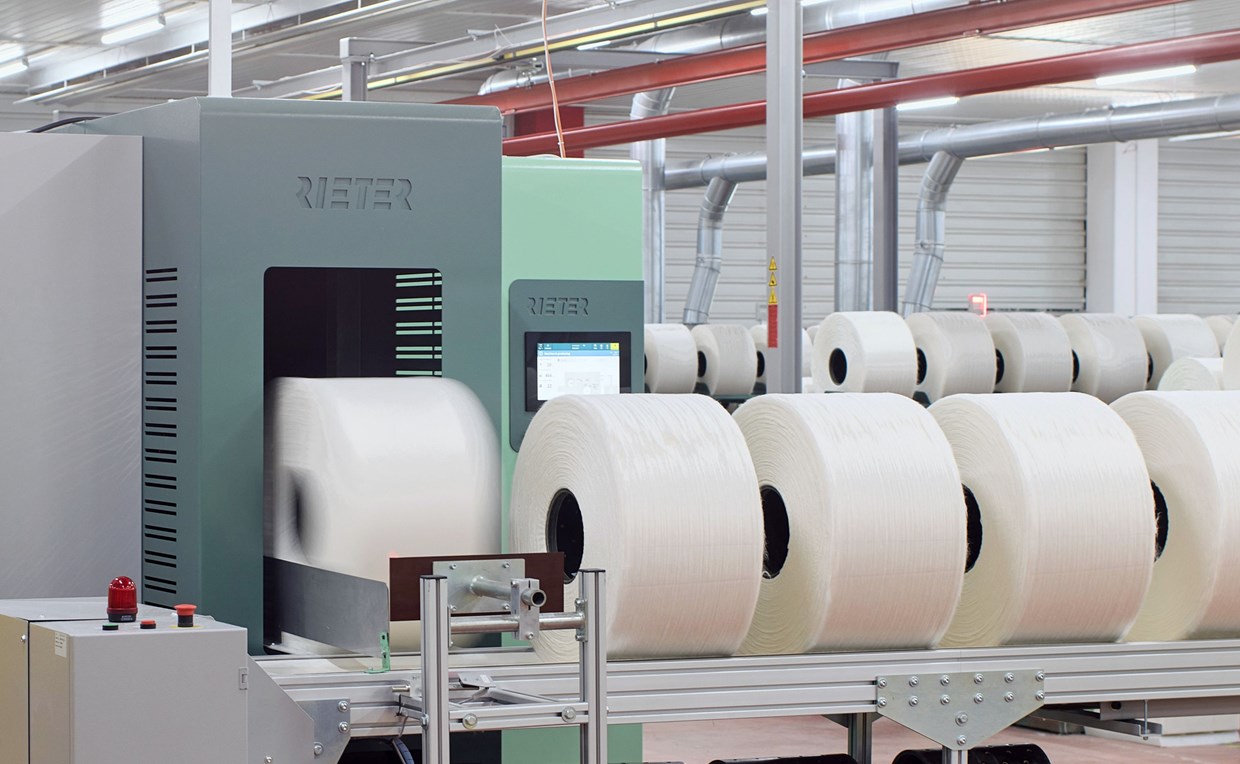
Guided by its materiality assessment, Rieter has developed a strategy that positions sustainability as a catalyst for future readiness and responsible growth. The sustainability strategy also supports the textile industry’s transition toward greater circularity.
The textile industry remains one of the most resource-intensive sectors globally. With an estimated 1.7 billion tons of CO₂e emitted annually, it is responsible for around six to eight percent of global emissions, making it a significant contributor to climate change. Spinning is a small and highly technological step in the overall textile manufacturing process, yet it can enable positive effects in downstream processes, saving raw materials and energy while promoting circularity.
Spinning: an enabler of decarbonization and circularity
Spinning accounts for about 30 percent of the energy used in garment manufacturing, much of which occurs in regions where electricity generation is still heavily reliant on fossil fuels. As a leading supplier of spinning technology, Rieter recognizes the critical role it plays in shaping a more sustainable future.
Rieter actively contributes to the decarbonization of the textile value chain: The company drives innovation in energy efficiency, supports the shift to low-emission technology and helps customers to reduce their environmental footprint.
Despite growing awareness of sustainability, textile recycling remains critically underdeveloped. Currently, less than 1 percent of used garments are recycled into new clothing, while the majority ends up in landfill or incineration. This represents a missed opportunity in closing the loop within the textile value chain.
One of the key challenges lies in the complexity of reprocessing recycled fibers, which limits the scalability of circular solutions. Rieter works continuously on developing advanced spinning technology that supports the processing of recycled fibers, including both post-consumer and post-industrial textile waste.
Rieter’s state-of-the art technology and in-depth textile expertise is designed to handle the unique characteristics of recycled materials, such as shorter fiber lengths and variable quality, and at the same time maintain high yarn quality. Thus, the company supports the transition toward a circular textile economy.
Sustainability strategy: engineered the Rieter way
Rieter has developed a targeted sustainability strategy. It addresses the most relevant environmental, social, and governance topics for the business and its stakeholders based on the findings of its materiality assessment and the identified material topics.
The strategy is grounded in a structured approach under the acronym Rieter (Risks, Impact, Efficiency, Transformation, Empowerment, Resilience). It begins by evaluating risks and understanding their impact, then focuses on enhancing resource efficiency within its own operations and through Rieter technology in the spinning process. Rieter drives transformation through innovation, fosters empowerment among its people and partners, and strengthens its own resilience to ensure long-term sustainability and responsible growth. This strategic approach ensures that sustainability is not only a commitment, but a core driver of Rieter’s future readiness and responsible growth.
The following sustainability targets are integral to Rieter’s long-term strategy and business model. They support the company’s ambition to lead the spinning technology sector in sustainable innovation, ensuring operational resilience and creating lasting value for key stakeholders and the planet.
Environmental targets | |
Renewable energy usage | Rieter plans to transition to 90 percent renewable energy use at all production sites by 2030, significantly reducing its operational carbon emissions. |
Net zero emissions | Rieter is committed to achieving net-zero greenhouse gas emissions by 2040, and thereby aims to decouple its growth from its environmental impact. |
Sustainable product sales | By planning to triple the sales share from sustainable solutions, particularly repair services and retrofitting, from 2022 to 2030, Rieter plans to promote circular economy principles and extend the lifecycle of the machine base. |
Social and Governance targets | |
Workplace safety | Rieter plans to maintain a high safety standard. The goal is to target fewer than two occupational accidents per million hours worked, reflecting the company's commitment to a safe working environment. |
Diversity and inclusion | Rieter is committed to increasing the proportion of women in the company. The aim is to ensure that by 2030, at least 30 percent of leadership positions are held by women. With this, Rieter aims to promote the creation of a more inclusive and diverse leadership team. |
Sustainability governance
The Board of Directors of Rieter Holding Ltd. defines the company’s sustainability strategy at the Group level and sets goals and priorities, while the Group Executive Committee is responsible for implementing the sustainability strategy at the operational level.
The internal Sustainability Committee, which was formed in 2024, comprises leaders from the areas of supply chain, finance, legal, occupational safety and environmental protection, communications and human resources as well as sustainability. The Committee meets every two months to review the progress on sustainability initiatives. In 2025, the Committee met six times, chaired by the CEO. The finance department collects the non-financial data, thus providing the basis for transparent reporting. Product and market-related measures, such as optimizing the energy consumption of individual spinning systems, are the responsibility of the respective country organization. The Rieter subsidiaries are accountable for site-specific measures in the areas of energy, GHG emissions, waste, biodiversity and occupational safety. They are supported by technical experts at Group level.
Board of Directors | The Board of Directors defines the goals and priorities of the sustainability strategy. | |
Group Executive Committee | The Group Executive Committee implements the sustainability strategy at the operational level and monitors progress and target achievement. Sustainability is a regular agenda item. | |
Sustainability Committee | The Sustainability Committee develops the conceptual framework for the implementation of the sustainability strategy. | |
Finance department | The finance department collects the non-financial data and ensures transparent reporting. | |
Country organization | Product and market-related measures are the responsibility of the respective division. | |
Corporate risk management | Corporate risk management supports the local Rieter companies with site-specific measures. | |