Vision 2027: the fully automated spinning mill
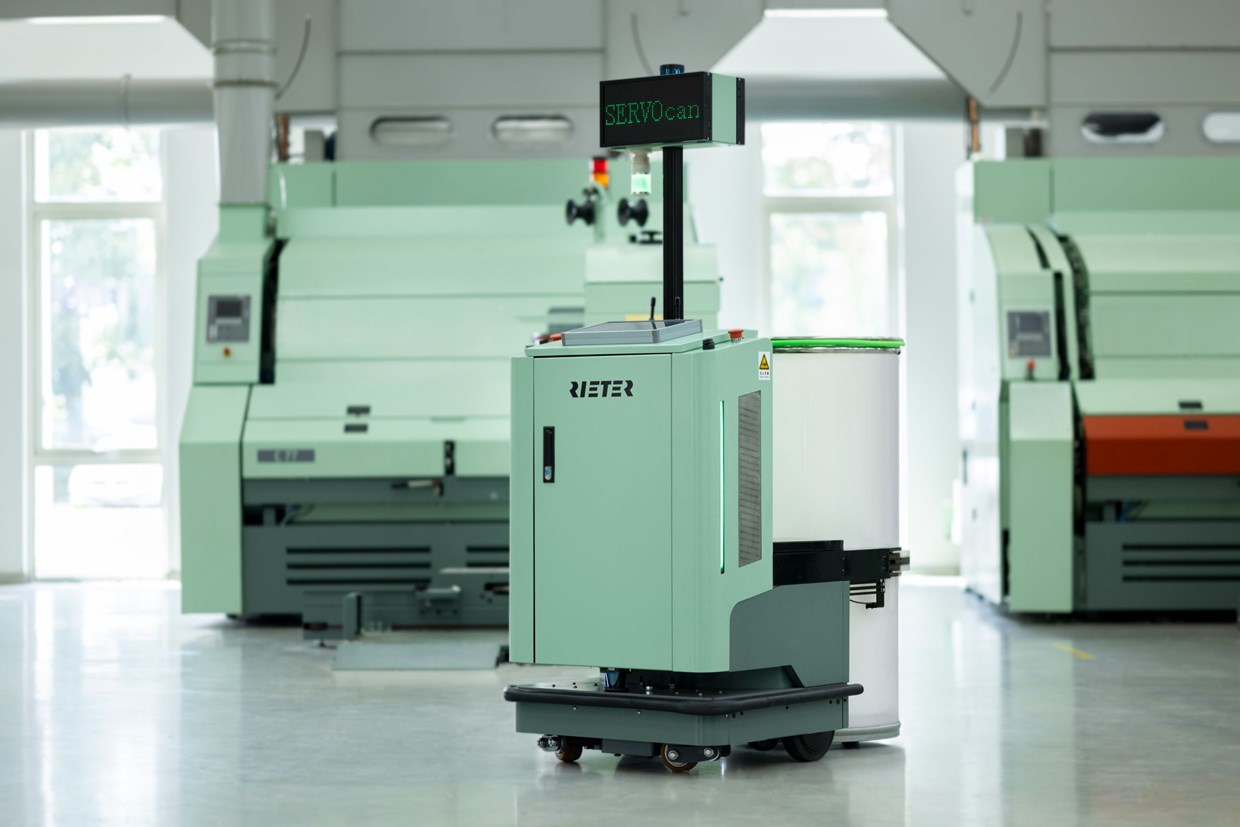
Spinning mills, like many other areas of the manufacturing industry, are facing a severe labor shortage. In numerous regions, companies are unable to fully utilize their production capacity due to staff shortages and the resulting knowledge gaps, leading to an adverse impact on their productivity and efficiency. This issue is set to intensify in the future. Automation is thus essential to remain competitive. Rieter is therefore planning to realize a fully automated spinning mill by 2027.
Staple fibers are converted into yarn in three main stages: fiber preparation, spinning preparation, and end spinning and winding. The number of steps in the process varies depending on the end-spinning technology used and encompasses up to ten steps, including combing for ring, compact and air-jet spinning. This work is demanding and exhausting, which makes it difficult to recruit and retain workers.
Rieter is very familiar with the challenges faced by its customers, which is why it has long focused on the automation of key process steps. One example of this is combing, which plays a key role in yarn quality in ring and especially compact spinning. For this process, Rieter was able to reduce personnel requirements by using a fully automated combing system with the automated lap change and batt piecing system ROBOlap in combination with the fully automated lap transport system SERVOlap.
Another example is end spinning. Rieter’s automated piecing robot ROBOspin automates yarn repairs in the event of breakages during ring spinning, which reduces manual effort enormously.
Further automation, step by step
Rieter is now working step by step in pursuit of fully automated production by 2027. An overview of the degree of a spinning mill’s automation level is obtained by comparing the number of qualified operators to a defined number of spindles and kilograms of yarn produced per shift. In a manual spinning mill, a compact yarn – meaning a high-quality standard yarn – currently requires around 20.6 operators per 10 000 spindles and 1.9 tons of yarn per shift. Rieter plans to produce 1.9 tons of yarn per shift per day by 2027 with just three qualified employees per 10 000 spindles. This corresponds to automation of around 85 percent of the activities that were previously performed manually.
Customers can already make their processes more productive using the following automation technologies presented by Rieter at ITMA 2025 in Singapore:
- efficient bale transport with driverless transport system,
- flexible transport of the corresponding size cans between machines by means of a driverless transport system, and
- packaging solutions including steaming, palletizing and labeling.
This interim step reduces the number of qualified operators required: Instead of 20.6 operators for 10 000 spindles, only 5.6 are now needed.
One significant advancement is the automation of can transport, which takes care of physically demanding tasks and relieves operating personnel of this burden throughout the spinning process. At the same time, it increases process reliability and efficiency in the production workflow. The automated packaging line, from packing the yarn package to palletizing and labeling, also sets new standards: it replaces numerous manual tasks with highly precise, fully automated processes. These new automation solutions pave the way for full automation, making work in the spinning mill far simpler. They also provide valuable insights for the ongoing transition to fully automated spinning.
Vision 2027: a fully automated production process
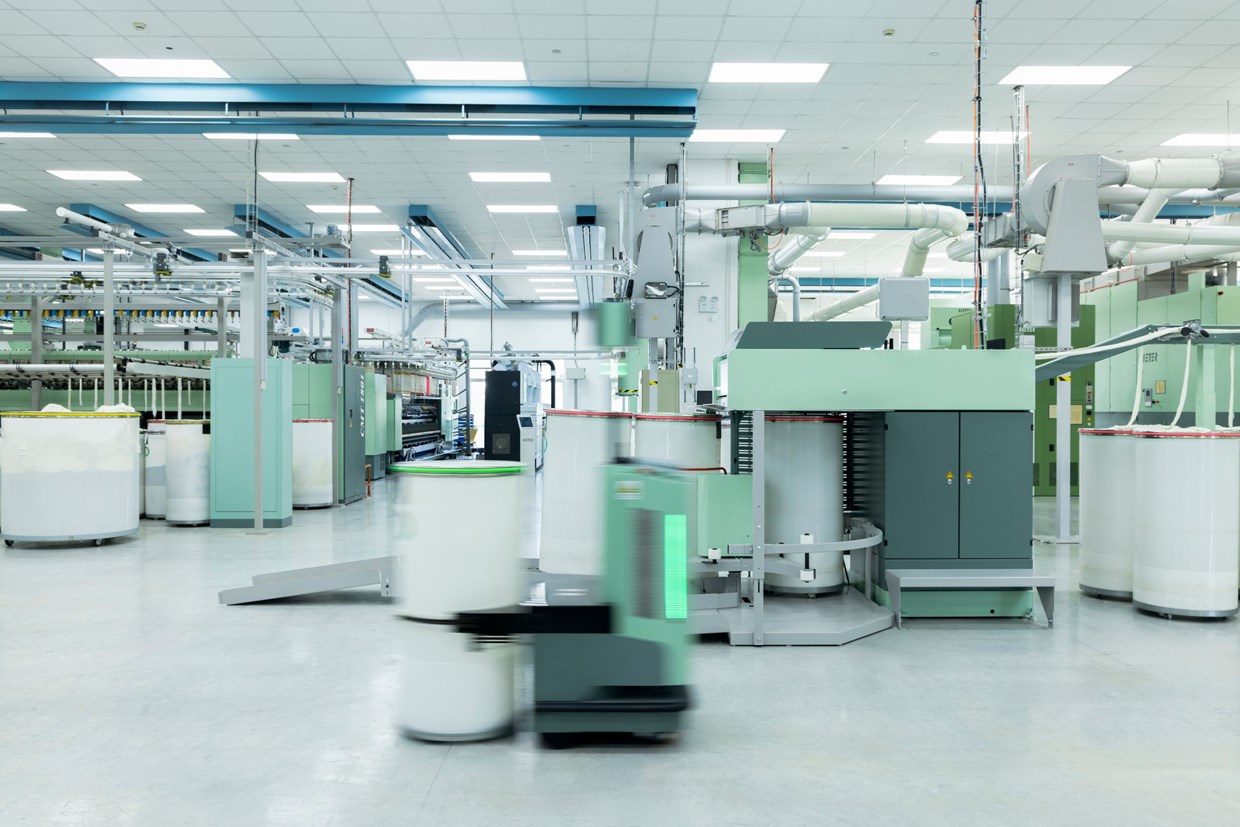
A milestone in textile automation is set to be reached in 2027: the unveiling of a fully automated benchmark plant. This vision extends far beyond conventional approaches. At the heart of this plant is a fully automated, integrated production process with intelligent, digitally networked systems. Automation starts with the raw materials: the time-consuming and potentially dangerous manual removal of the steel strips from the bales is replaced by robot-assisted solutions. It ends with a packed yarn package, which is ready for shipment ex-works.
Automation and digitization go hand in hand in this respect. The use of Rieter’s digital spinning suite ESSENTIAL ensures full control over the automation solutions and allows for complete traceability of all process steps. All relevant data is recorded here and made available in real time. This transparency is a key competitive advantage, particularly with regard to the traceability of textile products.
A profitable investment with vision
As fascinating as state-of-the-art robot technology, digital networking, and autonomous systems are, one question matters above all else at the end of the day: will the investment pay off? The answer is clearly in the affirmative. The introduction of a fully automated system is a strategic investment in efficiency, quality assurance and future viability. Operating costs – encompassing personnel, defects, scrap, and downtime – account for a much higher proportion over the life cycle of a plant than the initial investment in the technology.
Automation reduces dependence on human resources, ensures reproducible quality, and enables stable, predictable production processes, regardless of shift work or location. This is why spinning mills that want to remain competitive in the future already rely on automation solutions from Rieter today. From 2027, they will be able to fully automate their operating processes with Rieter and reach all new heights in terms of efficiency and performance.